Monday, 7 June 2010

World Cup Daily arrives


The first edition of the Guardian's Football Weekly team's World Cup podcast has just been released. Usual informed analysis and a good preview of what to expect from the upcoming weeks:

World Cup Daily 

When a podcast opens with lines such as: 'What kind of message would it send to the world if England won the World Cup? What kind of template is that for being the best in the world? To have a bloated, over-inflated league, have a rubbish coaching structure, don't look after your youngsters and get a foreign manager in and you too can win the World Cup', it's clear that those involved don't pull their punches.

In complete contrast I made the foolish mistake of relaxing my guard enough to try watching BBC Three's 'World Cup's most shocking moments', still available for your own misery on Iplayer. Talking head shows are generally abysmal, and despite some interesting clip choices, getting in Mathew Horne from Gavin and Stacey to comment on incidents he clearly had not seen before making the show, as if recalling fond memories, was aggravating.

Any programme that can make Peter Crouch's wooden acting one of the least problematic issues of the production deserves a kicking, and getting third party 'celebrities' to repeat cliches about German efficiency is an impressive waste of money.

The programme is mildly symptomatic of a greater malaise in the general punditry knowledge base across our media as a whole. There are great analysts out there, but they are not in the mainstream. It cannot be right that we can send people like Ian Wright and Andy Townsend to such major competitions in place of pundits such as Sid Lowe and Gabriele Marcotti.

Wednesday, 12 May 2010

Coalition context

While many Liberal Democrat supporters are up in arms over the new-born coalition with the Conservatives, it's perhaps worth taking a step back and looking at the bigger picture.

Whilst the idea of the two parties working together is still slightly unbelievable and potentially alarming to the Lib Dem grass roots support, many of whom will have voted Lib Dem in order to keep the Tories out, some context is needed.

Firstly, it's worth remembering that this is the only way, given the currently flawed electoral system that we have in place in this country, that the Liberal Democrats were going to have any form of power in the forseeable future.

Secondly, such a coalition need not mean that the Liberal Democrats bow to the Tories on every issue. Providing they stand up and make their voices heard within the coalition, the effect could instead be that they are capable of muzzling the Tories on their more aggressive policy, whilst still offering the voters aspects of their own manifesto that they campaigned on.

So whilst having Cameron as the leader may not be pleasing to Liberal Democrat voters, in many ways they now have the lesser of two evils. It's the Conservatives in power yes, but tied to a party that will still involve Nick Clegg and Vince Cable, who won't let them run roughshod, and will have the ability to force them into fairly significant concessions.

Thirdly, from a neutral's perspective, this is politically exciting. We are truly entering a new era of politics following this deal, and we will only be able to evaluate the coalition, for better or worse, in the months and years ahead.

Sunday, 9 May 2010

Election night BBC TV review


Election night is usually enjoyable television; as the night rolls on and the presenters become more tired, tetchy and unpredictable, it generally has the potential to create moments of unintentionally entertaining action.

The BBC coverage has been criticised in the days following the event, in some cases rightly, but some without justification.

Those who watched would largely agree that the idea of having a party boat on the Thames was very much misguided. Not only did the BBC manage to assemble a group of 'celebrities' and commentators who were very easy to detest (not to mention Andrew Neil) that by 2am most were hoping for a stray torpedo to latch onto the craft, but it added absolutely nothing of substance to the analysis.

Why would we want to hear from Joan Collins about David Cameron making the ideal next 'President' for our country, or a candidate for the most cringe-worthy moment of television for 2010 when Bruce Forsyth, drunk on a cocktail of his own ego and senility, quietened the guests behind him and attempted to engage them in his catch-phrase.

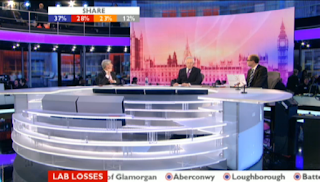
Back in a studio that featured the world's most unnecessarily large desk, David Dimbleby increasingly looked like an elderly man shrinking into the electronic scenery. In fairness however, he did a surprisingly good job in holding the presentation together for what seemed like an eternity, disappearing at 9am for what was presumably a short nap somewhere under that desk.

It boggles the mind that the BBC can somehow still manage to have communication systems with exceptional amounts of lag, so that when Dimbleby addressed presenters outside the realms of the main studio there was often a three or four second delay between question and answer.

This isn't helped when you have Dimbleby and the trigger-happy Jeremy Paxman, who frequently interrupted the silent delays to add additional questions, further complicating the resulting exchanges. Paxman finally exploded out of his patience zone when Lembit Opik lost his seat unexpectedly, leading to the first heated trading of words of the night.

Meanwhile Jeremy Vine's graphics were rendered largely redundant. The whole purpose of utilising graphics should surely be to simplify the results coming in and make the whole process more coherent. Instead, Vine had to explain every aspect of the confusing swirling mess unfolding behind him. It was as if Vine was stuck in some strange parallel universe comprised of terrifying white voids interspersed with flying coloured panels, and a House of Commons filled with computerised twitching MPs.

Back in the studio, Emily Maitlis and Peter Kellner perhaps did the best job of assessing the voting share and swing in each seat, providing some much needed brevity and clarity.

Whilst ITV were apparently quicker in both showing results and the swing in each seat, what I saw of Channel 4's alternative election night was disappointing. It felt as though the tone of the show was misjudged, not offering the expected Mitchell and Brooker led-satire as much as cheap jokes and average comedy shows. Mitchell in particular looked uncomfortable in the environment, short stand-up material broken up by a woman in the audience with a machine-gun laugh.

It would have been more productive to have had a full Channel 4 news produced show, with occasional breaks for Brooker to offer his more visceral take on the developing events.

Saturday, 1 May 2010

When the media indulges in overkill

It was a fascinating week in British politics, because the media started to realise that they no longer had complete control over the electorate.

The papers and television tried in vain to make the public angry about the Prime Minister calling Gillian Duffy a bigot, but the reality was that we could see through their tactics.

The media's problem is that that they are too transparently hypocritical. On the one hand they ask us to be cynical about our politician's actions, and the next minute, as on Wednesday, they ask us to hold them to impossibly high standards.

So whilst the 24-hour news channels and Jeremy Paxman were frothing at the mouth over Gordon Brown's actions, the opinion polls revealed that the majority of people were largely apathetic, or could at least see the humorous side.

In this regard, programmes such as The Thick of It have helped. When we see the ministers desperately struggling to positively spin events in the face of a savage media and impressionable public, it helps humanise their plight. On Wednesday we simply couldn't help but feel some degree of empathy for the Prime Minister.

The fact that Gillian Duffy did indeed sound bigoted when talking about non-descript immigrants 'flooding in' did little to help her cause. When Newsnight went onto the streets of Rochdale (15.53 into the programme) in the aftermath, they found plenty of other people willing to spout similarly prejudicial views.

It would be nice to think that this could mark the point in election campaigns where the media stops deifying the general public, and that we can stop holding ourselves self-righteously as if we are all-knowing on all matters political.

It would also be nice to think that the media in this country might also try and reflect the real opinions of people on the street and not try to set the agenda themselves, as if operating in a vacuum.

Murdoch press
Slightly out of date piece now, but interesting none-the-less. I link it at the risk of looking as if I am covertly campaigning for the Labour party.

Gary Younge
Good article. Go and read.

Thom Yorke
And to keep things unnecessarily varied, a typically powerful song from Thom Yorke.

Sunday, 11 April 2010

El Clásico review


Barcelona were more than comfortable in victory in last night's Clásico, a game that played in an entirely different manner to a typical La Liga game.

From the moment that the Catalans took the lead, they looked unlikely to relinquish it. Real created little danger, and were unable to keep possession for any meaningful length of time.

Typically in the Spanish game, defenders give more space to the ball carrier, stick to positions rigidly, and only attempt win the ball when they are certain they can.
They wait until the attacker runs at them before engaging, and even then usually to shepherd the player away from the goal rather than leaping in with two feet.

From the attacking standpoint, this approach rewards precise passing and moving between the more static targets, perhaps best exhibited by Barcelona's midfield and attackers, who play neat one-two's and take only the minimum necessary number of touches before laying the ball off again.

This style of play encourages players to run at each other and attack players one-to-one, as long balls and hopeful passes that are hit without thought (a sad mainstay of the English game) are easily intercepted.

It also shows respect towards the attacking game. The space is there if you make use of it, and defenders will only challenge for the ball when they are certain of winning it. This combination of factors creates a game that has the easy-on-the-eye flair, whilst providing more pace and tempo than the Italian variety.

However, this all went out the window last night as soon as the whistle was blown. Players closed each other down aggressively all over the pitch, responding to the sheer pressure of the occasion and the baying of the fans.

As a result, we were inevitably treated to a less spectacular game, but not without its stars. Indeed, those players who adapted best to the rough and tumble game were mostly wearing the red and blue shirts, most notably Xavi and Messi.

Messi-watch

Disturbing to see that we have already reached the stage where Messi is becoming deified. Every touch now seemingly requires the commentators to comment on his brilliance. After a blatant handball in the first half, Sky Sports' Terry Gibson said that the booking had been harsh, despite having just admitted that the player was using his arm to gain a deliberate advantage.

Messi of course, is not new to causing handball controversies. I wonder what our pundits would say about that goal if it had happened last night.

To summarise; it would be nice if pundits could admire players without fawning over them blindly.

Messi's goal though, gets better with every viewing.

Thursday, 8 April 2010

Election overload

Whilst the media constantly asks the question of how we can engage an apathetic electorate in the run up to an election, it would be nice if they could occasionally take a look at themselves as being where the blame may lie.

On Tuesday, the day that Gordon Brown announced the date of the election that we had already known for a year, the BBC saw fit to fill the entire one o'clock news bulletin with an election preview, despite there being absolutely nothing of interest happening.

This is on day one of an exhaustive month that lies ahead. There is such as thing as election overload, and even as someone who has an avid political interest, I found it tiresome after 10 minutes.

Messi-watch
This is the week that England may finally have fully awoken to Lionel Messi's true brilliance. Although this blog can not be accused of having been guilty of such ignorance, I find it frustrating and shameful that it has taken many of our pundits this long to appreciate his ability, as did Sid Lowe. In this age where it is so easy to access foreign football coverage with such ease, it seems strange that we have waited this long to crown him as the world's best.

After all, he ran rings around Chelsea in the same competition back in 2006. It's yet another example of Britain's short-sightedness when it comes to acknowledging foreign football. This was further in evidence last night following Manchester United's exit from the Champions League. Both Mike Ingham and Alan Green trotted out the usual lines about United having fallen to an inferior team.

However you judge their relative strengths, the facts are that Bayern won and United are out. Whether Bayern are inferior has nothing to do with it. It was another case of English pundits bristling with irritation that the Premier League had failed to produce a European Cup semi-finalist.

Thursday, 1 April 2010

Richard Littlejohn


It's easy to criticise, and Richard Littlejohn gave a perfect example of this on Question Time, exhibiting the expected behaviour of the obligatory right-wing columnist (see Starkey, Mackenzie, Hitchens) on the show.

While the party representatives attempted to dissect and argue the issues, every time Littlejohn assumed that the audience were getting lost in debate going over their heads, he leapt in and targeted a populist response with the familiar 'they're all the same' and 'what the British people want' rhetoric.

At one point in the aftermath of his attack on the Liberal Democrats, Littlejohn rested his hand on Sarah Teather's in a slightly sickening manner, bringing to mind the image of a lecherous news editor drooling over his new intern. Teather, to her credit, waited the moment out, although did subsequently struggle to formulate her subsequent argument, as any human would given the same position.

The most absurd moment was when Littlejohn had to bully a questioner into silence when the plausible suggestion that he was the BNP's favourite columnist was raised.

The Guardian writer Victoria Coren was also a weak link on the show however, offering meaningless throw-away points and pathetic jokes on serious issues. This does raise the question of why we need anyone other than politicians on Question Time. Why can we not have representatives from the Greens and UKIP and debate real policy instead?

The issue is that in this country we have a big problem with failing to hold our media accountable. David Dimbleby bumbles through in the manner of a Boris Johnson without the pseudo-charm, interrupting and cutting off the politicians, but consistently fails to cross-question the newspaper journalists on the points they make. When, at the end he turned on Littlejohn over the Daily Mail's reporting of Joanna Lumley, Dimbleby for a moment realised he had the columnist on the ropes, and immediately retreated.